🚀 Antigravity 2.0
When Google Set Us Free and Decoupled the AI Agent from the IDE
To be completely honest, for the past year, I’ve felt exhausted by the IDE ecosystem cold war.
Think about it:
-
Want to try the latest cutting-edge AI from Google? “Use Project IDX!”
-
Want native Android AI integration? “Open up the latest Android Studio!”
-
Want to experience Microsoft's smart assistant? “Install VS Code Copilot!”
It felt like there was a massive, invisible wall. As developers, we were forced to make a frustrating compromise: leave our beloved text editor behind just to taste the latest breakthroughs in AI intelligence.
Yet, we all know one undeniable truth:
The best editor so far, with all its vast ecosystem, shortcuts, and unmatched customizability, is still VS Code (at least in my opinion).
Forcing a developer to switch editors is like forcing a left-handed person to write with their right hand. It’s doable, but it’s awkward, slow, and completely disrupts the sacred state of developer flow.
But all of that frustration was shattered at Google I/O Extended yesterday.
Google took a massive leap that left me with goosebumps and immense respect: they chose to set us free.
🧠 A Complete Revamp: Decoupling the Brain (AI Agent) from the Body (IDE)
Google's move yesterday was completely unexpected. They are no longer trying to monopolize our screens by forcing us into a web IDE or proprietary, rigid extensions.
Instead, they went for complete decoupling.
Google has drawn a clear line between:
- The IDE / Code Editor: The place where developers type, navigate code, and manage their projects (where VS Code still holds the crown).
- The AI Agent Engine (Antigravity 2.0): The autonomous reasoning engine that focuses purely on thinking, problem-solving, crafting implementation plans, and executing precise tool calls.
This philosophy is incredibly reminiscent of Anthropic’s heavy focus on autonomous AI Agents and open standards like the Model Context Protocol (MCP).
Google has finally realized that the true power of an AI coding companion is not about how aggressively it dominates your editor's UI, but how intelligently and autonomously it can operate within your local workspace—regardless of the editor you choose to use.
🎨 A "Wow" Visual Refresh: From Gemini to Antigravity
Google didn't just rebuild the engine under the hood. They also introduced a complete visual refresh across their entire developer AI product line, from Google Gemini to Antigravity itself.
The new design feels exceptionally premium and alive:
-
Clean, sophisticated glassmorphism panels that float elegantly on the screen.
-
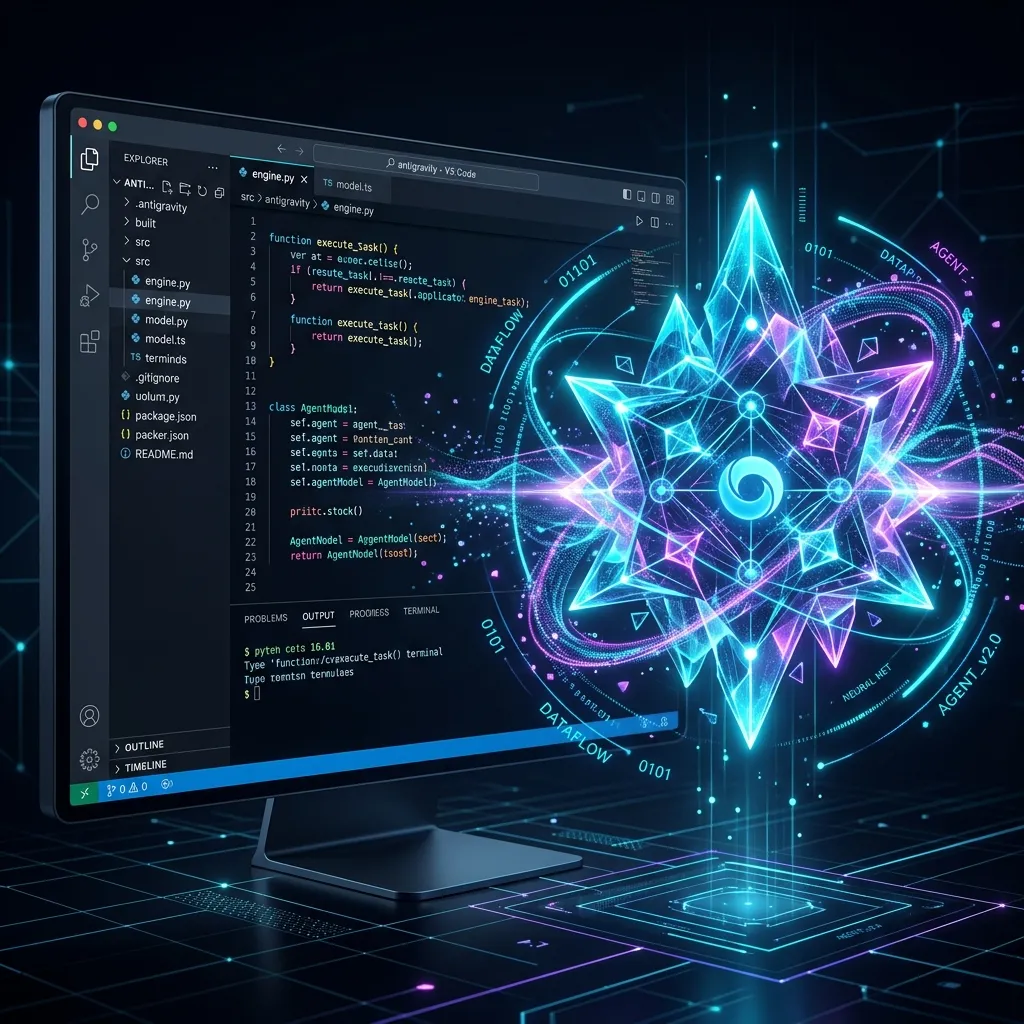
A curated, modern color palette with smooth neon cyan and electric purple gradients inspired by DeepMind.
-
Subtle micro-animations on every interaction, making the agent's thought process feel vivid, interactive, and responsive.
This isn't the rigid, blocky enterprise software design of the past. It’s a modern interface that gives you the distinct feeling of collaborating with a highly sophisticated, tidy digital partner right in your terminal.
⚙️ How Antigravity 2.0 Runs Autonomously Alongside VS Code
With this decoupled architecture, the way Antigravity 2.0 operates is incredibly elegant.
When I work, Antigravity 2.0 runs as an autonomous engine in my local terminal. It has structured, secure access to my workspace:
-
It can analyze the directory structure deeply.
-
It can create comprehensive implementation plans (
implementation_plan.md) and tracking lists (task.md) autonomously. -
It can invoke external tools via MCP to browse the web, analyze data, or generate visual representations of UI changes.
While Antigravity 2.0 is busy performing autonomous heavy-lifting in the background—writing clean files, resolving bugs, drafting technical documentation—I remain comfortably inside VS Code.
I can watch my files update in real-time, see my task list get checked off piece by piece, all while maintaining my focus state and workspace settings completely intact.
This is no longer just smart autocomplete or a chatbot waiting in the corner of your screen.
This is a true autonomous partner that knows its boundaries, respects your workflow, and acts systematically.
🤝 A New Philosophy: Freedom is the Best Driver of Productivity
With Antigravity 2.0, Google is sending a crystal-clear message to the developer community:
"We don't care which editor you use. Our job is to build the best autonomous reasoning engine to help you build."
This shift makes integrating an AI Agent into your real-world workflow seamless. The editor migration friction is completely gone. Just spin up the engine in your local workspace, connect it, and let the magic happen while you remain in your comfort zone.
To me, this is DevOps and software engineering that actually makes sense.
🌱 Final Reflection
The release of Antigravity 2.0 at Google I/O Extended yesterday wasn't just a minor version bump with minor speedups or better LLM accuracy.
It is a fundamental paradigm shift.
It is the moment Google stopped forcing rigid, closed ecosystems and began genuinely embracing developer freedom. By decoupling the IDE from the AI Agent Engine and delivering a stunningly premium visual refresh, Google has set a new benchmark for how human-agent collaboration should feel.
And from what I'm experiencing right now... the future of agentic coding looks brighter, freer, and much more exciting.
What do you think? Has the era of rigid, bloated, all-in-one AI IDEs officially come to an end, and has the modular, autonomous AI Agent era truly arrived?