📚 Building a Book Agent with n8n — From Teaching to Practical Implementation
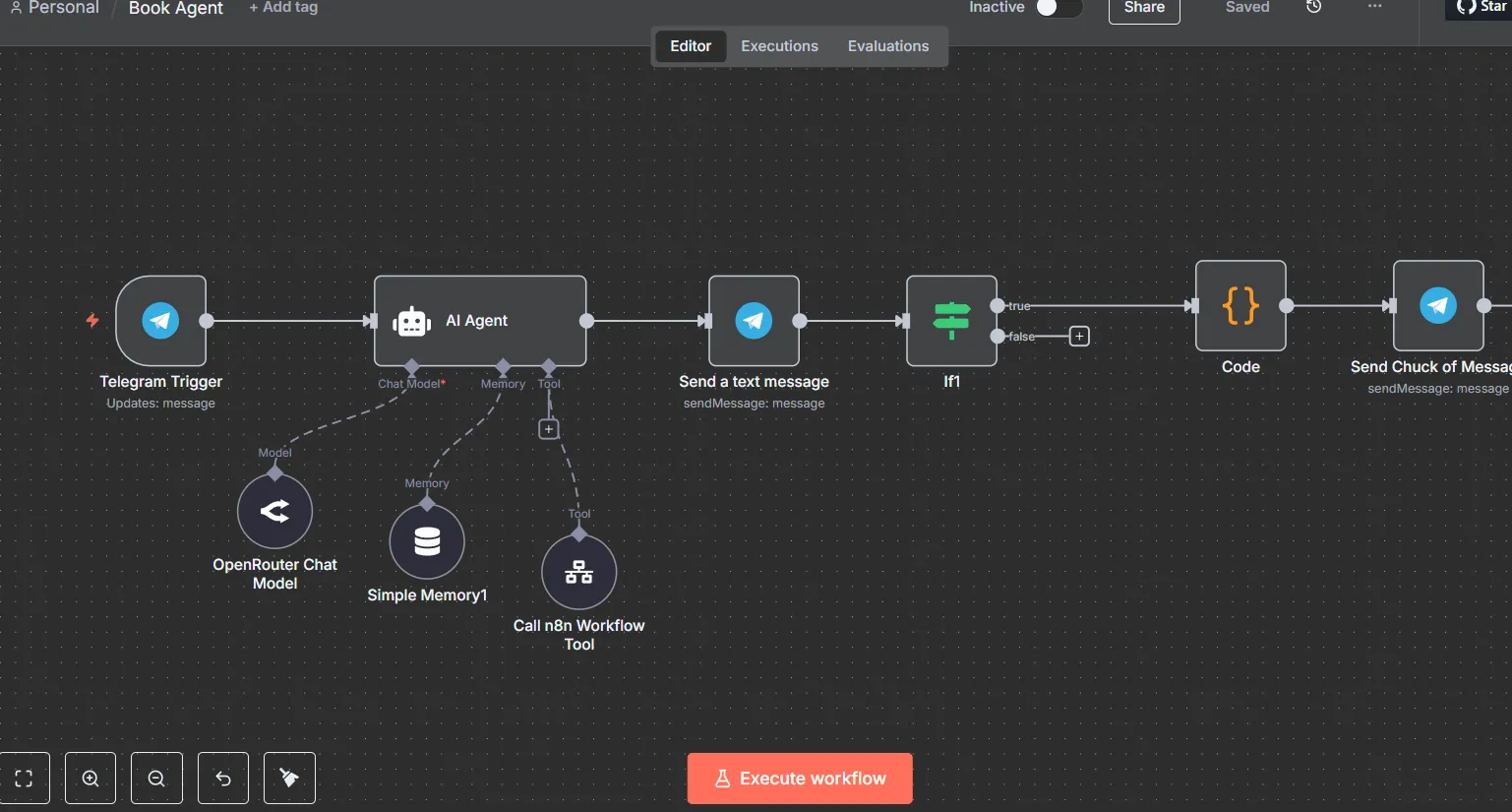
Previously, while working as a mentor, I had the opportunity to teach n8n to several mentees. The focus was more on core concepts: how workflows work, automation flows, and how n8n can be used to connect various systems.
However, to be honest, at that stage I hadn't actually used n8n directly in a real project. My understanding was still at a theoretical level — enough to explain, but not enough to feel the complexities of the real world.
All that changed when I started building a concrete use case: a Book Agent.
🎯 What is a Book Agent?
A Book Agent is an AI Agent designed to:
-
receive user questions about books,
-
understand context and intent,
-
retrieve data from a database (via an SQL Agent),
-
and then compose relevant and contextual answers.
On paper, this concept looks simple. But when I started building it, I realized that the main challenge isn't in the AI, but in system design and workflow orchestration.
🧠 From Teaching to Practice: A Changed Perspective
When I started using n8n hands-on, one thing was immediately apparent:
n8n is not just a no-code tool.
n8n forces its users to think in systems:
-
where the input comes from,
-
how data is processed,
-
when logic should be separated,
-
and how errors are handled.
Every node is not just a "step", but part of a system that must have a clear responsibility.
At this point, my previously conceptual understanding truly began to take shape.
🧩 Book Agent System Design
In the Book Agent, I separated the roles between components:
User Input ->
Book Agent (Conversation & Context) ->
SQL Agent (Query & Data) ->
Book Agent (Response Composition)
This separation is important so that:
-
logic remains simple,
-
the system is easy to develop,
-
and the workflow remains readable.
Sub-workflows in n8n play a major role here. They aren't just an extra feature, but the foundation for building a modular and scalable system.
⚙️ n8n, DevOps Mindset, and Fast Delivery
As someone who enjoys DevOps, I'm accustomed to seeing systems as a collection of small, interconnected components. The way n8n works aligns perfectly with this mindset.
Every workflow can be treated as a system unit:
-
with clear input,
-
an explicit process,
-
and controlled output.
Another thing that makes n8n interesting to me is its ability to support fast delivery. Many ideas can be tested immediately without the need to build a new service or excessive boilerplate. The focus goes straight to value.
🚧 Learning from Real-World Constraints
As the Book Agent began to be tested further, various constraints appeared.
1. Limited Free AI Models
Free-tier AI models have daily limits. This forced me to rethink:
-
not every step needs AI,
-
AI Agents must be used strategically,
-
workflows must be efficient.
2. Platform Policies (WhatsApp Business API)
Technically, the n8n workflow worked well. However, platform policies — such as cross-country restrictions on testing numbers — meant the system couldn't be used operationally right away.
Here I learned that:
technical success doesn't always mean operational success.
3. Agent Integration
Connecting the Book Agent with the SQL Agent can't be done haphazardly. A clear data contract is needed:
-
input structure,
-
output format,
-
and response expectations.
Many failures weren't actually because of the AI, but because of inconsistent data flows.
🧾 Important Lesson
From this entire process, one thing became increasingly clear:
Teaching a tool and using it directly are two very different things.
A mature understanding is formed when facing:
-
real constraints,
-
inexplicit errors,
-
and realistic system design needs.
Now, n8n is no longer just a tool I once taught, but a tool I use, whose limits I understand, and for which I know exactly when it’s appropriate to use.
🚀 Conclusion
Building a Book Agent with n8n taught me that:
-
a good system is not the most complex one,
-
but the one with the clearest flow,
-
the simplest design,
-
and the one that delivers value the fastest.
For me, learning from practical experience like this is far more valuable than just understanding theory.