🎓 From GitHub Classroom to Vinci LMS
The Quiet Evolution of Programming Practicums
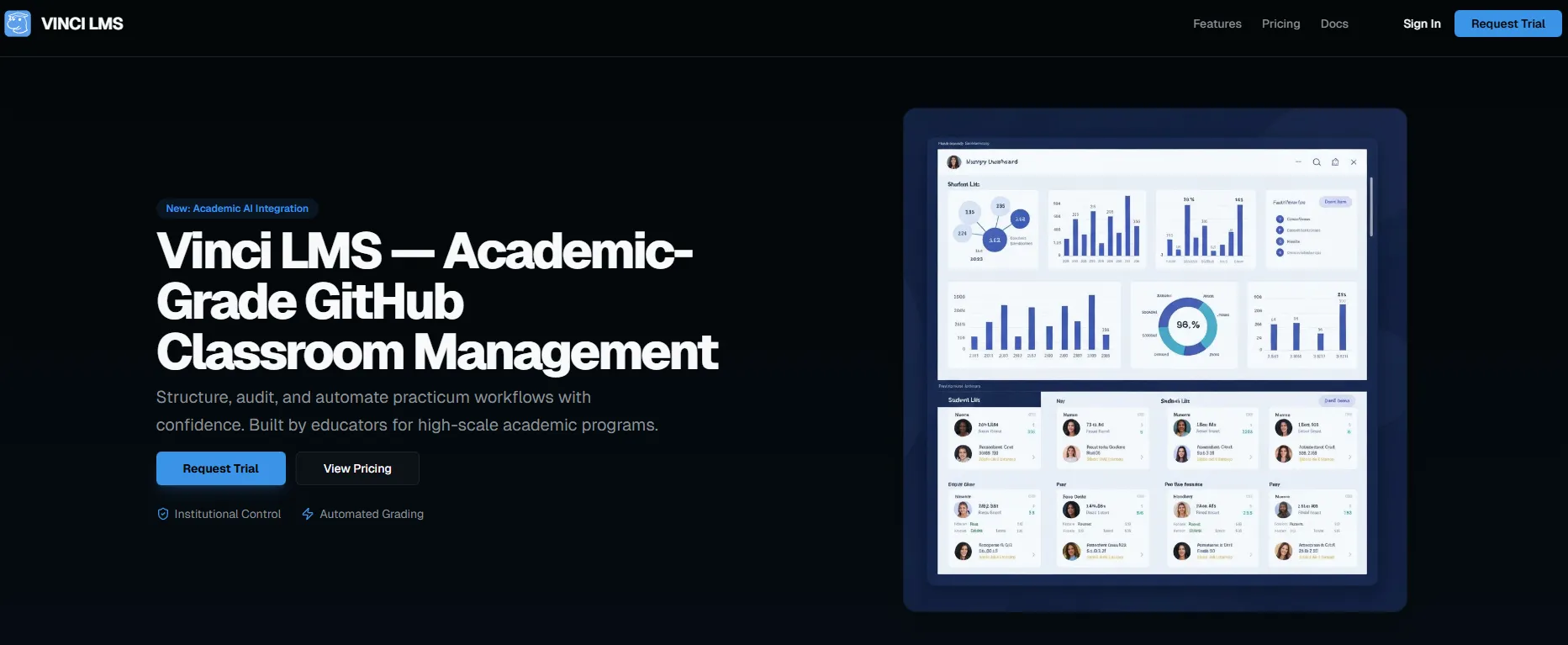
Vinci LMS was not born from grand ambition.
It emerged from small technical problems that kept repeating every semester, until solving them manually no longer made sense.
At first, the goal was simply to be neat.
Then, to be consistent.
And eventually, it became clear:
This is not about tools. This is about systems.
🧩 The Starting Point: GitHub Classroom (Conceptually Correct)
Conceptually, GitHub Classroom is not wrong.
It provides:
-
a repository per student
-
native integration with GitHub
-
a developer-first workflow
For programming practicums, this is a solid foundation.
The issue is not in the core features.
The problem lies in operational details—small things that seem trivial, but become critical as the number of classes and students grows.
⚠️ The Real Problem: Inconsistent Repository Naming
One classic yet crucial issue:
GitHub Classroom repository naming is not truly consistent.
In practice:
-
students rename repositories themselves
-
typos appear across repos
-
random suffixes are added
-
naming formats differ between classes and semesters
As a result:
-
recap scripts fail to run reliably
-
teaching assistants must check manually
-
commit analysis automation becomes fragile
-
submission tracking loses determinism
At this point, GitHub Classroom loses the very property an academic system needs most:
consistency and data readability.
📩 The Role of Telegram (Not for Discussion)
Telegram was never intended to be an LMS,
and never used for academic discussion.
Its role was very specific and limited:
-
🔧 Repository renaming
-
📦 Assignment submission recap
Telegram was chosen because it is:
-
fast
-
real-time
-
familiar to everyone involved
Not because it is ideal,
but because it was a practical way to cover gaps left by GitHub Classroom.
🧪 A Temporary Technical Fix: Shell Scripts
With no official solution available, a familiar engineer’s response emerged:
-
custom shell scripts
-
used to:
-
bulk rename repositories
-
normalize naming formats
-
generate submission recaps
-
These scripts worked.
They were genuinely helpful.
But one realization slowly surfaced:
“If every semester requires additional scripts, then the system itself is incomplete.”
Shell scripts became both a helper
and a warning sign of deeper structural issues.
🚨 The Breaking Point: When Workarounds Become a Burden
Initially:
-
1 class → manageable
-
2 classes → still under control
-
many parallel classes → chaos begins
What followed:
-
scripts grew more complex
-
edge cases multiplied
-
human dependency remained high
-
documentation became hard to pass down
At this point, one thing was clear:
Workarounds do not scale.
A system must be built.
🧠 The Birth of Vinci LMS
Vinci LMS was not designed to replace GitHub Classroom.
On the contrary:
Vinci LMS is a system layer built on top of GitHub Classroom.
Its purpose:
-
normalize data
-
read repositories consistently
-
eliminate ad-hoc scripts
-
move operational chaos into a repeatable and auditable system
🏗️ The Core Philosophy of Vinci LMS
1️⃣ GitHub Remains Where Students Code
-
no custom editors
-
no artificial sandboxes
-
real-world tooling stays intact
2️⃣ Vinci Handles What GitHub Classroom Ignores
-
academic structure
-
data consistency
-
automated recaps
-
accountable statistics
3️⃣ No More “Heroic” Scripts
-
no dependency on a single person
-
no magic commands without context
-
every process is documented and systematic
📊 From Recap to Insight
At first, the goal was simply:
-
clean repositories
-
working recaps
Once the data became consistent, more meaningful questions emerged:
-
who is truly learning consistently?
-
who only submits at the last minute?
-
whose progress is stagnating?
This is where Vinci LMS evolved:
from a recap tool into an academic observation system.
🧩 Vinci LMS Features & Roles
👥 User Roles
🟢 Admin / Practicum Coordinator
System authority holder
-
manage academic years & semesters
-
manage classes & sessions
-
import student rosters (CSV)
-
map Student ID ↔ GitHub username
-
view all repositories & grades
-
audit activity logs
-
export grades (CSV / Excel)
🟡 Lecturer
Academic decision maker
-
view student repositories per class
-
check submission status & lateness
-
input & finalize grades
-
view grade recaps
-
export grades
-
ask the AI agent (only their own class data)
🔵 Teaching Assistant
Technical operator
-
rename repositories (specific classes / sessions)
-
clone repositories
-
check submission status
-
input grades (optional)
Limitations:
-
❌ cannot finalize grades
-
❌ cannot manage global classes
🧩 Core Features
1️⃣ User & Permission System
-
GitHub OAuth
-
Role-Based Access Control (RBAC)
➡️ Secure and accountable
2️⃣ Roster & Class Management
-
CSV roster import
-
multi-class & multi-semester support
-
detect students who haven’t joined or whose repos are missing
➡️ Eliminates manual work
3️⃣ Repository Management (CORE)
-
bulk and per-class repository renaming
-
repository cloning
-
archive / lock repositories
-
repository status (normal / error / missing)
➡️ Solves GitHub Classroom’s core pain point
4️⃣ Assignments & Sessions
-
session setup (1–14, projects, midterms/finals)
-
internal deadlines
-
automatic late detection (last commit)
➡️ Lecturers no longer check repos one by one
5️⃣ Grading & Grade Recaps
-
per-student grade input
-
optional feedback
-
per-class & per-student recaps
-
CSV / Excel export
➡️ The most “paid-for” feature by universities
6️⃣ Activity Logs & Auditing
-
who did what
-
when
-
on which repository
➡️ Safe for accreditation and grade disputes
7️⃣ 🤖 AI Agent (System Assistant)
Can:
-
answer questions from lecturers, TAs, and admins
-
recap class data & grades
-
explain repository and submission errors
-
rename repositories
-
delete data
-
finalize grades
-
and more
8️⃣ 📊 Student Coding Analytics
Per-student analytics based on commit history and code structure:
-
commit patterns
-
work consistency
-
solution evolution
-
coding style & structure
-
AI-generated code indications (heuristic, non-punitive)
Used for:
-
identifying students who need guidance
-
lecturer reflection
-
practicum methodology evaluation
🎯 Why Traditional LMSs Are Not Enough
Conventional LMSs:
-
focus on files
-
focus on deadlines
Programming practicums:
-
live through process
-
grow through iteration
-
improve through errors
These two worlds need a bridge.
🌱 Closing
Telegram and shell scripts were not mistakes.
They were realistic engineering solutions.
But when temporary solutions:
-
are used continuously
-
passed down every semester
-
become core dependencies
They stop being solutions.
Vinci LMS exists to break the workaround cycle
and give programming practicums a system that is structured, calm, and accountable.
Not because complexity is desired,
but because reality demands it.