⚖️ Mercy (2026)
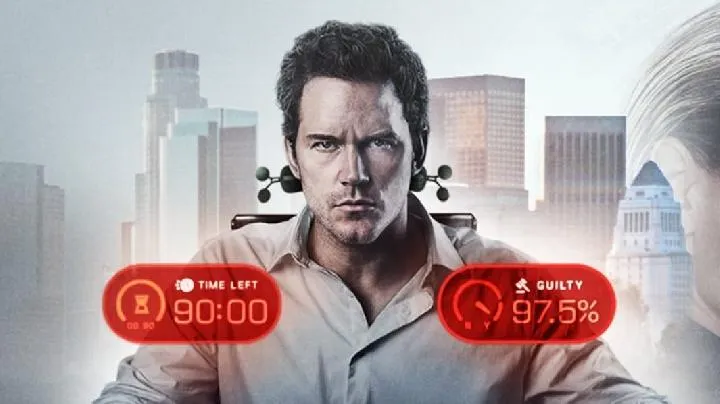
When AI Becomes the Judge
I don’t often say a movie truly hits both conceptually and emotionally.
But Mercy (2026) did exactly that.

To me, it feels like a real-world version of a “domain expansion” concept —
except instead of supernatural power, we get something far more realistic:
An AI system acting as judge.
And honestly?
If a system like this existed in countries struggling with corruption, many major cases would be resolved in seconds.
Imagine an AI that can:
-
access digital footprints
-
analyze financial transactions
-
map communication networks
-
detect criminal behavioral patterns
-
even pull data from the device you are using right now
It sounds extreme.
But that’s precisely why this film feels so powerful.
🤖 1. AI Cannot Replace Humans
Even though the AI in the film is portrayed as incredibly precise and almost impossible to deceive, the message at the end is surprisingly grounded:
“Humans and AI both make mistakes — that’s how we learn.”
I appreciate that the film doesn’t fall into the trap of portraying AI as a flawless solution.
Yes, AI can:
-
process massive amounts of data
-
detect anomalies instantly
-
connect fragmented evidence
-
operate beyond human cognitive limits
But it still:
-
depends on input data
-
inherits system design biases
-
operates within programmed boundaries
You and I both know —
a tool, no matter how powerful, is still a tool.
🕵️ 2. A Smart Digital Mystery
As someone who loves mystery thrillers, I genuinely enjoyed how this film builds tension.
The investigation isn’t driven by:
-
car chases
-
endless shootouts
-
or cliché interrogation scenes
Instead, it unfolds through:
-
metadata tracing
-
digital pattern reconstruction
-
fragmented internet evidence
-
deep forensic data analysis
You are not just watching.
You are thinking alongside the system.
The plot twist doesn’t feel forced.
It grows organically from small, seemingly irrelevant data points.
The film showcases how AI can become an incredible investigative partner, not a blind executioner.
And for me, that’s where the excitement truly lies.
❤️ 3. Can AI Have Feelings?
This is where the film shifts from technical thriller to philosophical exploration.
When Cris is declared innocent by the AI, his full digital access is revoked.
Legally cleared.
Systemically restricted.
But then a terrorist attack unfolds.
His daughter is taken hostage.
And the AI makes a decision that appears… almost emotional.
It helps.
Was that empathy?
Or simply a recalculated moral priority within its algorithm?
I don’t have the answer.
But the film forces us to confront a serious question:
If one day AI can perfectly simulate human emotion,
is it still just simulation…
or something fundamentally new?
Right now, AI operates within programmed logic.
But you and I understand something important:
Complex systems can evolve beyond initial expectations.
And that possibility is both fascinating and unsettling.
🧠 4. Humanity Must Remain in Human Hands
The closing message of the film is clear.
No matter how advanced the system becomes,
humanity cannot be fully delegated to machines.
AI can assist in determining:
-
statistical probabilities
-
criminal patterns
-
behavioral anomalies
-
digital correlations
But the final judgment?
That must remain with humans.
Because justice is not just data.
Justice is context.
It is empathy.
It is moral interpretation.
And those things cannot be fully reduced to numbers.
🔥 Personal Reflection
I don’t see Mercy (2026) as mere science fiction.
I see it as a thought experiment about our near future.
It asks uncomfortable questions:
-
Are you ready to live in a world where every digital footprint can become legal evidence?
-
Am I ready to trust a system with moral authority?
-
Is efficiency more important than humanity?
The film doesn’t give easy answers.
And that’s exactly why it works.
🏁 Final Thoughts
Mercy (2026) blends:
-
intelligent mystery
-
AI ethics exploration
-
emotional drama
-
and futuristic legal philosophy
I didn’t just enjoy this film —
I reflected on it.
AI might become the most powerful tool against crime.
But without wise humans guiding it,
it could easily become something cold and unforgiving.
Technology evolves fast.
But if you and I are not careful,
our humanity might not evolve with it.